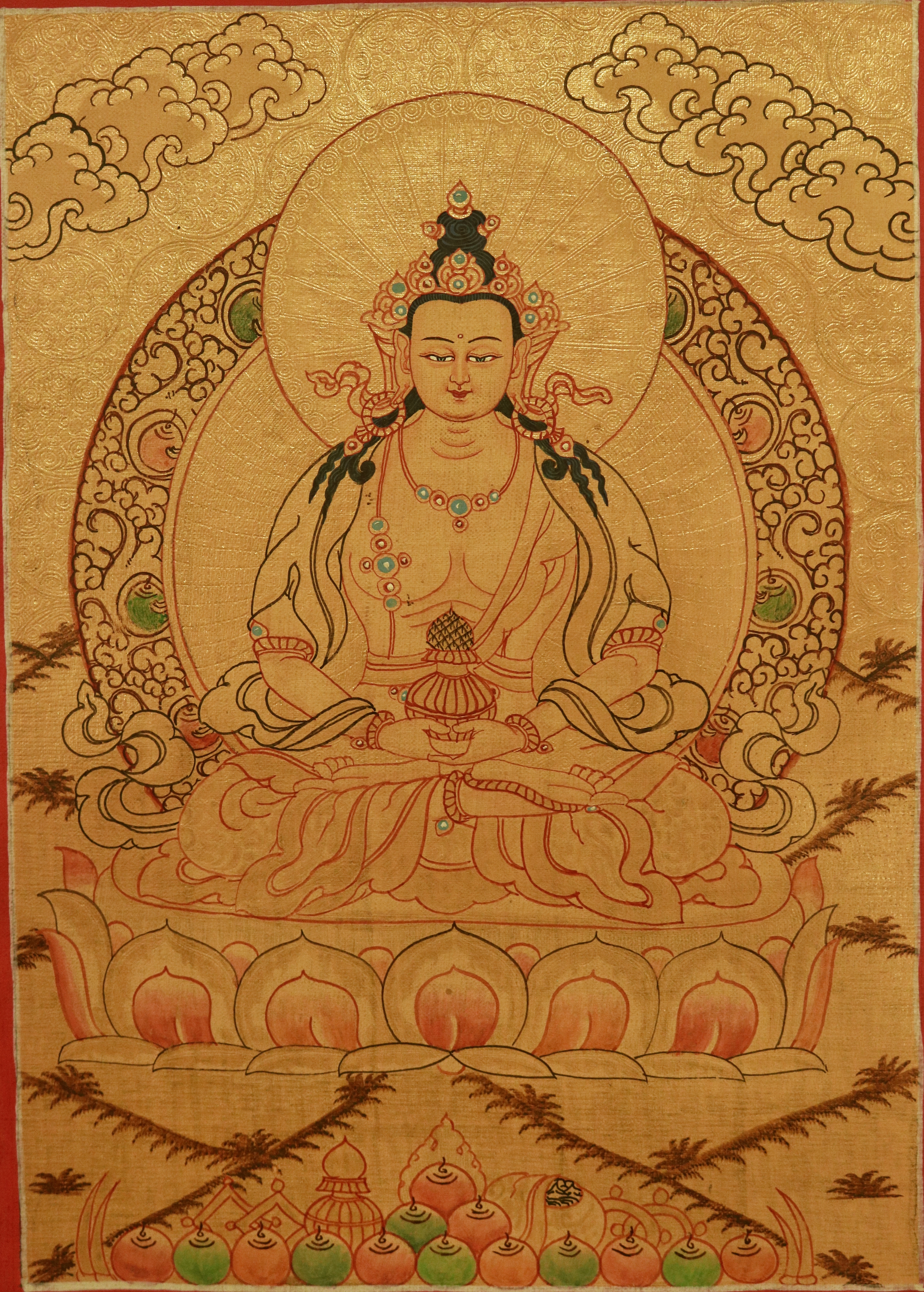
Monday, November 22, 2021

What to do if followers of other religions say that they pray for us

A friend recently wrote to me and said that he feels insulted by the fact that some of his Christian or Muslim co-workers often tell him that they are praying for him to abandon his Buddhist Path and turn to their god. This was my answer:

Try to not become upset, but have compassion for them like a grown up towards ignorant children or like a sober person towards a drunken fellow who doesn't know what he's saying.


Shakyamuni Buddha said in the Sutra on the Questions of Maudgalyayana (as quoted by Shinran in his Kyogyoshinsho, chapter II) that those who "follow the ninety-five wrong paths" are blind and deaf. He said: " I call such people 'those without eyes' and 'those without ears'."

Thursday, November 18, 2021

False or unsettled shinjin


A friend asked me what is false or unsettled shinjin? Then he gave me a quote from Kyogyoshinsho:

“1. One’s faith is not sincere; at one time it exists and at another it does not;

2. One’s faith is not single-hearted, because it is not firm;

3. One’s faith is not constant, because it is mingled with other thoughts.”

Monday, November 8, 2021

Thoughts after a religious service with my Nembutsu friends


I recite in the middle of my personal chaos and everybody in the Amidado (Amida Hall), recites in the middle of his/her personal chaos. We do not transform this chaos into order or purity, we don’t think at all to purity or negativity, we just recite and the sacred sounds of sutras and Nembutsu come from Amida, carrying us, embracing us, accepting us.  

In Jodo Shinshu we leave everything to Amida Buddha, our bad karma and our good karma. We do not rely on our good karma to attain Buddhahood in the Pure Land and our bad karma does not count, only Amida is important. Recitation reminds us of this, when no matter how we feel, we continue to recite.

Also, our everyday life is sometimes good or bad, we chose what we like and reject what we don’t like, but in the Amidado we don’t do this. We follow only the Path, not our own likes and dislikes, not our own opinions, but the Dharma.

Chanting in the middle of our chaotically mental states reminds us that exactly in the middle of our everyday life with its ups and downs, we follow the Nembutsu Path. We have to keep going in the middle of our own chaos, we have to walk the white path in the middle of the river of fire and water.

Shakyamuni urges us to go to the Pure Land, and Amida is calling us. The path is here, in the middle of our misery, ignorance, blind passions and personal difficulties. It is the path Amida has built for us. While we recite the Name and feel our minds are disturbed by personal thoughts or other problems, we just let them be as they are, and we continue to say....... NA MO A MI DA BU, NA MO A MI DA BU, NA MOA MI DA BU.......


Thursday, November 4, 2021

The three vows of salvation


Generally speaking, Buddhist practices taught by Shakyamuni Buddha can be classified into two groups:

 1.      meditative practices

2.      non-meditative practices

Meditative practices include various types of meditation and visualization that we can find in all schools of Buddhism from Theravada to Mahayana and Esoteric Vajrayana[1].

Non-meditative practices include chanting sutras, observing precepts, abstaining from evil or doing various good acts, etc. These non-meditative practices are said to generate merit or positive karmic energy that help the practitioner attain higher rebirths or spiritual states. They can also be transferred or directed by the practitioner toward various goals, including his future Enlightenment.

Monday, November 1, 2021

Worldly benefits and otherworldly benefits of Nembutsu

Question:  According to what I have read in some teaching of the Chinese Pure Land school, they say that it is incorrect to say that Nembutsu does not bring benefits to this life, like for example, longevity and other physical and worldly benefits which is in contradiction to Shinran’s thought.  I for my part contemplate the ten benefits which have nothing to do with my longevity or other worldly benefits that I know I do not have and I'm not very interested in them either.  Why do these schools wish for more benefits as if going to the Land of Amida is not enough?

My answer: If one does not have aspiration for birth in the Pure Land then he does not meet the requirements of the Primal Vow: “entrust yourself to me, say my Name and wish to be born in my land”. It is very clear that according to the Primal Vow we must say the Nembutsu with faith in Amida Buddha and aspiration for birth in His Land. Amida did not say that we should say the Nembutsu while wishing to get worldly benefits and long life. However, due to a combination of personal karma and Amida’s help we might indeed receive more benefits than the usual ten, including long life, although this is not why Amida manifested His Name and instructed us to say it as an expression of faith. Honen Shonin said:

Friday, October 22, 2021

Mind precedes matter

Question: Can matter evolve and become conscious?

Answer: Matter itself without a conscience is not alive and life does not appear out of dead matter. Life has always existed, so it does not come suddenly into existence from matter. Life or conscience of a certain being takes a form (body) according to its karma, so we can say that conscience inhabits matter, not matter becomes conscious.

Also, conscience precedes matter because matter appears due to the personal karma of one conscience and the collective karma of many consciences. Thus, the outside world we see around us as matter is actually the karmic manifestation of conscience. It is the dream and the illusion of conscience. When we dream at night we also see various worlds and outside objects but when we wake up in the morning we realize they are not real but the effects of our minds and thoughts during the daytime.

However, not even when we wake up in the morning we are not awake as we are still in the samsaric dream, so the dream at night is just a dream within a dream.

We believe that a dream is something not real when compared with our waking life, which we regard as truly real. For Buddhas, however, neither our dreams during the night nor our perceptions during the day are real. So, the matter we see around us appears due to our minds and as a correspondence to our minds. If we have minds filled with cruelty, then the matter around us will appear as fire and various punishments and our bodies will be the bodies of hell dwellers. If our minds are filled with stinginess then our bodies will take the form of hungry spirits, if our minds are dominated by animal instincts for food and sex our bodies will take the form of animals and so on. Also, the Enlightened Ones (Buddhas) have glorious Sambhogakaya bodies free of obstacles because their minds are enlightened and free.

Thus, again, mind precedes matter.

Thursday, October 21, 2021

Again on the idea that faith in Amida comes from Amida - very simple explanations

There are many who get stuck at the idea of shinjin (faith) coming from Amida Buddha, or being Amida's gift. However, this is a very simple thing, and you should understand it in a simple way, so that it may not become an obstacle.

First of all, shinjin or simple faith in Amida is like when you do not know how to fix your car and you trust John who is a mechanic to fix it for you. In our case, you cannot attain Buddhahood by yourself and you trust Amida Buddha to help you attain it by taking you to His Pure Land.Your trust in John arises because you heard he is a very skilled mechanic and you saw him doing other repairs. So, in truth, John is the one who makes you trust him.

Also, let’s say you have a best friend. To have faith in your best friend is, in fact, answering to his love and to the fact that he is constantly there for you so, in fact, your trust in him is his gift. You trust him because of him.

Monday, October 18, 2021

False (mundane) merits vs True (supramundane) merits

Question: What does it mean to seek to be born in the Pure Land through a false, deceitful and poisoned good?

My answer: To seek to be born in the Pure Land through a false, deceitful and poisoned good means to aspire to be born in the Pure Land through transferring one’s personal merits. Shinran said that personal merits are always mixed with the poison of ego, ignorance and attachments, so he considered that we do not actually have genuine merits. In relation with this, we should remember the story of the meeting between Master Bodhidharma and Emperor Wu of Liang.

It is said that when Master Bodhidharma came to China, Emperor Wu called him and asked him: “I’ve built many temples and I’ve offered many lands to the path of the Buddha; now please tell me what merits have I gained? Bodhidharma’s answer came shocking but true: “None, not one merit.” Why Bodhidharma said that? It was because the merits the emperor described above were worldly merits gained with a mind full of attachments and lacking the wisdom of ultimate Reality.

Friday, October 15, 2021

How can one know that he received shinjin (faith) if he has no access to a temple or priest?

Question: “Because nothing physical happens or is done to the person receiving shinjin (baptism /Dharma transmission, etc.) how can that seeker know he/she has indeed received shinjin (faith) and attained the rightly established state? This question above assumes that the person referred to has no physical access to a Shinshu Buddhist temple or priest, which is a sad reality across most of the world except for Japan.”  
 
My answer: Fortunately, in our school there are neither gurus nor masters who can give or confirm the receiving of faith in the heart of the practitioner. Jodo Shinshu is a personal and exclusive relation between Amida Buddha (a real and living Buddha) and the person who has faith in Him. They are like mother and child.

Thus, the Mother (Amida) is always sending her love to the child and she knows if the child entrusts to her while the child (the follower) knows that he is loved and has faith in the Mother.

Thursday, October 14, 2021

On those who are not satisfied with Nembutsu only


Shinran Shonin said:

"Those who, it appears, will never attain Enlightenment

All attack the practice of solely saying the Name.

The mark of destroying the teaching of sudden attainment[1]

Is that for them, the vast sea of birth-and-death will have no end".[2]

We must pay attention here as the passage refers not to attacking the saying of the Name, but the solely saying of the Name. This means they attack the true teaching of exclusively saying the Name of Amida Buddha (Nembutsu). Those are the false teachers who, while wearing the kesa of Nembutsu faith (Jodo Shinshu), mix the saying of the Name with various meditative practices and make great efforts in convincing others that there is no problem with this combination. In the same time, they call those who follow faithfully the requirements of Amida's Primal Vow in which only the saying of the Name, faith and wish to be born in the Pure Land are mentioned, to be fundamentalists.

My advice is to please stay away from those who are not satisfied with "solely saying the Name".

Honen Shonin said:

"Abandoning the miscellaneous practices and performing the exclusive practice of the recitation of Nembutsu are in accordance with the heart of Amida Buddha."[3]

To feel that the Name of Amida Buddha is somehow not enough for your religious life is a sign that faith (shinjin) is not yet firmly established in your heart. A true Amida devotee never thinks that something is lacking and is completely satisfied to say Amida's Name alone. He will never feel the need to add this or that meditation practice or this or that sacred mantra to his daily Nembutsu, and he will not pray to various gods and spirits. In the Primal Vow, Amida Buddha presented the guidelines for our religious life, "entrust yourself to me, say my Name, and wish to be born in my land".

So, we should do nothing else, but entrust to Amida Buddha, say His Name in faith and wish to be born in His Land after death.


[1] This is the teaching of sudden attainment of Nirvana upon birth in the Pure Land after death.

[2] Shinran Shonin, Hymns of the Dharma Ages (Shozomatsu Wasan)

[3] Honen Shonin, An Outline of the Doctrine for Birth in the Pure Land


Friday, October 8, 2021

On a teacher abandoning the Primal Vow

A few hours ago a friend showed me the message of Richard St Clair (Shaku Egen) posted on True Shin Buddhism Group from which I quote the most important sentence:

“My spiritual path has taken a very different direction, away from True Shin Buddhism and away from Buddhism in general”.

Here is my comment:

When you hear about a teacher leaving Jodo Shinshu and Buddhism after many years of writing, teaching and judging what is right and wrong, you should realize that person has never had shinjin (faith) but only knowledge and enthusiasm for the Dharma. As any enthusiasm is impermanent, it is inevitable that one day he will get tired and search for something else.

Dharma talks on my youtube channel